
SlotStars Identity Checks and Account Controls
 Available in GB
An account at SlotStars is linked to a named individual, payment ownership checks and rules for managing gambling activity. The platform describes photo ID, proof of address, funding verification and player controls. Those elements serve different purposes: some establish whose account it is, some affect how transactions are reviewed, and others help set boundaries on time and money. Understanding the division makes the account policies clearer than a single label such as KYC or responsible gaming.
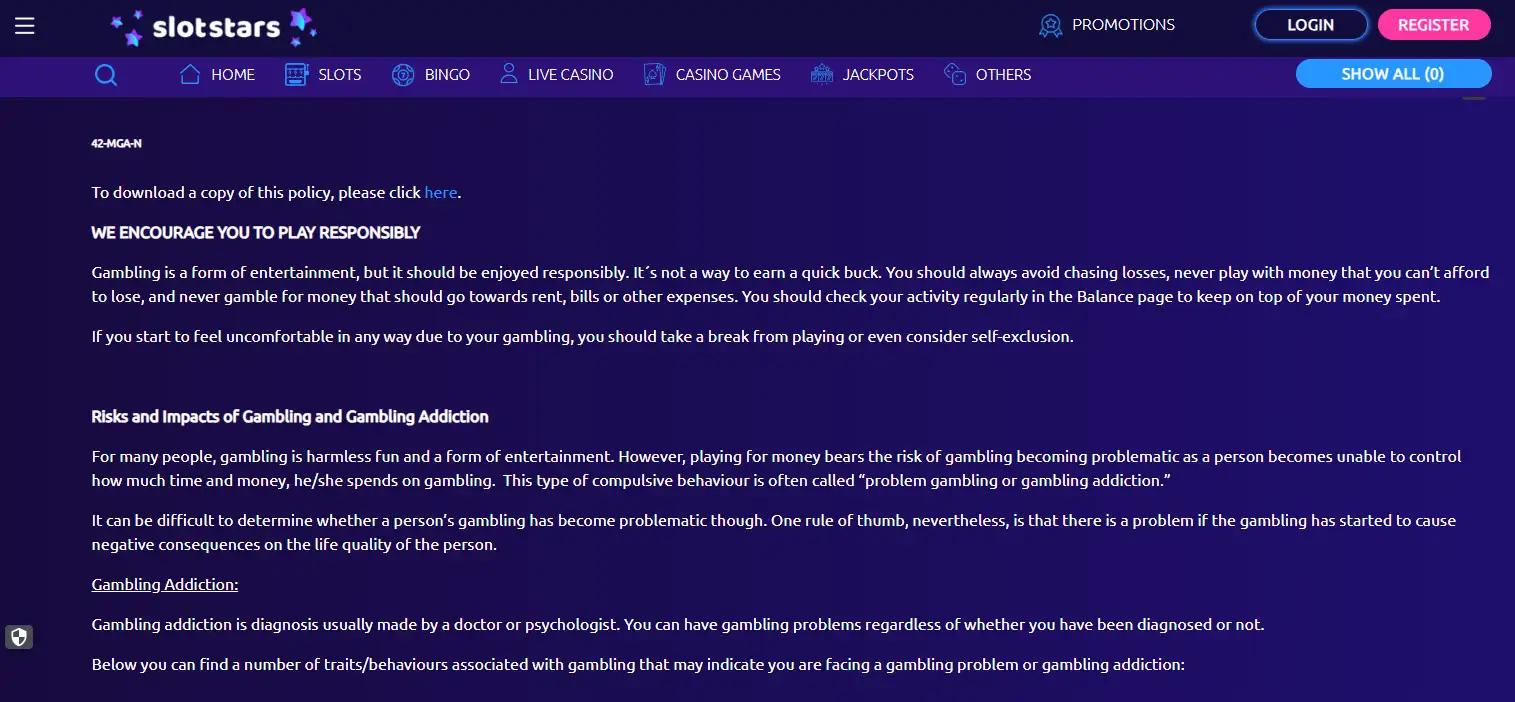
Table of Contents
- Cooling-Off, Temporary Suspension and Self-Exclusion Have Different Durations
- Account Identity and Payment Ownership Are Linked
- Support Channels Help Separate Questions From Payment Decisions
- Deposit Limits, Session Reminders and Self-Assessment Work at Different Points
- Verification Documents Have Distinct Evidential Jobs
- Questions About SlotStars Accounts
- Document Checks and Player Controls Extend Beyond the Balance
Cooling-Off, Temporary Suspension and Self-Exclusion Have Different Durations
SlotStars sets out several ways for account holders to interrupt gambling activity. Its responsible-gaming information lists cooling-off periods of 24 hours, 48 hours and seven days, along with longer temporary suspension choices of 30, 60 and 90 days. It also describes self-exclusion. Their durations and account effects differ.
A cooling-off period is a shorter interruption intended to place distance between an account holder and the next gambling session. Temporary suspension is a longer restriction of account access. Self-exclusion is a more serious commitment to staying away from gambling activity and should be understood through its applicable terms, rather than treated as a routine break. The central distinction is the amount of interruption being sought and the operator’s arrangements for applying it.
| Control | Published examples | Practical purpose |
|---|---|---|
| Cooling off | 24 hours, 48 hours, 7 days | Short interruption to gambling access |
| Temporary suspension | 30, 60 or 90 days | Longer fixed period away from the account |
| Self-exclusion | Separate exclusion option | A stronger barrier to further participation |
These options have meaning even outside an immediate gambling session. An account can carry a saved balance, a pending transaction or information that remains relevant during a period of inactivity. The terms of a break should therefore be distinguished from the separate payment and verification conditions attached to an account. Restrictions on play and the handling of money are related operationally, but they are not the same procedure.
Account Identity and Payment Ownership Are Linked
SlotStars connects account verification with the identity of the person who holds and funds an account. Its terms require payment methods to be in the named account holder’s name. Separate checks can concern identity, address and ownership of a card or electronic payment account. Together, those questions determine whether the platform can match a financial transaction with the registered account identity.
Payment ownership is more precise than showing that somebody possesses a card number or can open a wallet application. A review may require evidence connecting the instrument to the named individual. This matters around withdrawals because the operator can check a transaction’s source and intended recipient separately from whether its payment processor is technically capable of moving the amount.
SlotStars’ verification rules also allow reviews of account activity and source of funds. These can add a separate layer to ordinary identity checks. The document requested in one situation may therefore differ from the one needed in another: an identity document establishes who a person is, an address document establishes where they live, and funding evidence connects a payment channel to that person.
For the broader account-cashier relationship, the withdrawal processing explanation separates casino review time from external transfer time. A pending account check can delay the former even when the banking method itself is normally quick. The distinction is important because a fast method does not bypass an unresolved identity or ownership question.
- Identity: a current photo document matches the registered person.
- Address: a recent statement or utility document supports residential details.
- Payment ownership: a record connects the card or wallet account to its holder.
- Source of funds: additional financial evidence may be considered during a review.
The underlying purpose is account integrity, but disclosure of financial documentation also creates a privacy concern. Before sensitive information is shared with any financial or gambling service, its purpose and handling arrangements deserve attention. A document that reveals more information than the stated check requires can increase the consequences of an account-data incident.
Support Channels Help Separate Questions From Payment Decisions
SlotStars offers live chat, email and help information. The support email associated with its international casino profile is [email protected]. Those channels can help explain requested documents, account controls and transaction stages. They should not be confused with the payment processor or with an independent dispute resolution body: each has a different role in what happens to an account.
For example, a question about a pending withdrawal might involve two separate points. The first is whether SlotStars has completed an internal account or funds review. The second is whether a bank or e-wallet provider has finished its transfer stage. Asking about “the payment delay” without distinguishing these stages can blur the reason for the wait. An operator support channel may explain the account review while the receiving institution handles its own processing.
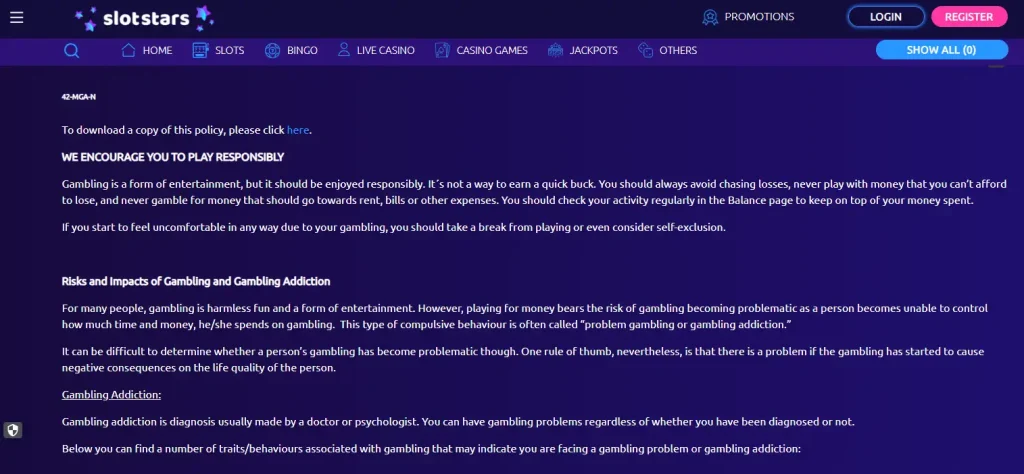
Support also has a place in responsible-gaming settings. A user who is uncertain whether a cooling-off period, temporary suspension or self-exclusion applies should seek clarification of the precise restriction. These controls are meant to help interrupt play; they should not be treated as another account feature to optimise or use as part of a gambling system.
- Separate a question about documents from a question about the movement of money.
- Keep a clear record of which account issue the support conversation addresses.
- Review any request for sensitive documents carefully before disclosure.
- For gambling harm, use independent confidential support rather than relying only on the casino’s help channel.
Support provides an explanation and communication route; it is not a guarantee that a withdrawal, identity check or account decision will be completed in a particular period. That distinction helps describe what the channel actually does without turning its existence into a broader claim about consumer outcomes.
Deposit Limits, Session Reminders and Self-Assessment Work at Different Points
SlotStars describes deposit-limit settings on daily, weekly and monthly schedules. These are controls over how much money can be paid into an account over a selected period. They do not change the probabilities of the games being played. A deposit limit places a boundary on funding behaviour, while a game outcome remains uncertain within that boundary.
The responsible-gaming material also lists automatic logout based on a time limit and game-status reminders at 15, 30, 45 and 60 minutes. These operate on the time dimension of a session. A reminder can make elapsed time visible; a logout can interrupt access once a set duration has passed. Neither mechanism fixes the final amount lost or won, since stakes, outcomes and number of rounds can vary considerably within the same period.
Another listed feature is self-assessment. Questions that invite reflection on gambling behaviour serve a different purpose from a numerical deposit limit. They can prompt somebody to consider whether gambling has become harder to control or is affecting other parts of daily life. They are informational aids, not a substitute for professional counselling when gambling is causing harm.
A useful way to understand the control set is by the behaviour it addresses. Deposit limits manage money entering the account; time limits interrupt ongoing access; reminders make passage of time harder to ignore; longer breaks and exclusion interrupt continued participation. The tools are complementary rather than interchangeable, and none changes the mathematical edge or variance of a casino game.
The SlotStars casino overview describes the wider product context, including games and banking. The account-specific controls are worth keeping separate because they affect the use of a profile even when the underlying game menu stays the same. Their practical value lies in limiting exposure and recognising harm, not creating better gambling outcomes.
Verification Documents Have Distinct Evidential Jobs
SlotStars’ document guidance names passports, driving licences and other official photo identification as examples of acceptable identity evidence. An ID connects a name and photograph to the person using the profile. Proof of residential address is another category: the guidance points to utility bills and bank statements and describes an issue date within the previous three months. These are different checks even when the same person’s name appears on both documents.
The operator can also request evidence of ownership of a funding method. Depending on the payment route, the relevant record could concern a card account or an e-wallet. A bank statement may sometimes be useful for more than one check, but the fact that a document was useful for address verification does not automatically mean that it answers a separate payment-ownership question. The request determines which details matter.
The requirement to produce identity or financial records can arise at particular thresholds or before a withdrawal, and additional activity reviews may occur. A person can therefore encounter verification after a period of otherwise routine use. That is why account checks should be understood as a continuing condition of the relationship, not merely a single step completed when an account first exists.
| Document category | Examples in SlotStars guidance | What it helps establish |
|---|---|---|
| Photo identification | Passport, driving licence or official photo ID | Registered individual’s identity |
| Address evidence | Recent utility bill or bank statement | Residential address |
| Funding ownership | Payment-account ownership evidence | Connection between the named account and payment method |
Because those records contain sensitive data, the security of the submission route and the treatment of unnecessary personal details matter. No general summary can promise that a particular document will be accepted in every case; the suitability of evidence depends on the stated check and account circumstances. The useful distinction is what each category is intended to prove and which decision depends on it.
For a separate discussion of the product’s permitted markets and legal position, see SlotStars licence and Australian status. Account-document requirements are a product rule; they should not be mistaken for a statement that an account is legally available in any particular location.
Questions About SlotStars Accounts
Which identity documents does SlotStars describe?
SlotStars lists passports, driving licences and other official photo ID as identity examples; utility bills and bank statements are examples of residential-address evidence.
How recent should SlotStars address evidence be?
The operator’s document guidance describes utility bills or bank statements issued within the previous three months.
What account breaks and exclusions does SlotStars list?
It lists cooling-off periods of 24 or 48 hours and seven days, temporary suspensions of 30, 60 or 90 days, and a separate self-exclusion option.
Which player-control features does SlotStars provide?
SlotStars describes daily, weekly and monthly deposit limits, time-based logout, session reminders and self-assessments.
Document Checks and Player Controls Extend Beyond the Balance
SlotStars combines familiar account-verification categories with a range of spending and time controls. Those features influence the account relationship in different ways: identification and funding checks establish who controls a profile, while deposit limits, reminders and breaks are intended to restrict or interrupt gambling activity. A card transfer, an identity review and a cooling-off period should not be treated as one process. Understanding each separately makes the rules easier to interpret and keeps the focus on personal information, financial exposure and account safeguards.